
Struggling to fund your R&D project? Here’s what your innovation could be getting.
You may recently have been introduced to the Australian Government Research and Development Tax Incentive Program highlighted in our previous article, Tax Incentives for Innovation.
The purpose of these articles is to bring awareness to the resources available, so we can see innovation thrive in Australia.
For today, we’ll touch on the types of companies that can claim the Research and Development Tax Incentive and the costs that they can claim.
Unfortunately, as listed on the Government website you are not considered eligible if you are:
- An individual
- A corporate limited partnership
- An exempt entity
- A trust
However, you are considered eligible if you’re a corporation that meets the following:
- Incorporated under Australian Law
- Incorporated under foreign law but an Australian resident for tax purposes
- Incorporated under foreign law and are both:
- a resident of a country with which Australia has a double tax agreement that includes a definition of ‘permanent establishment’
- carrying on business in Australia through a permanent establishment as defined in the double tax agreement.
There are additional rules for R&D entities that may need to be considered in the case of consolidated groups and R&D partnerships.
[Reference: This information was provided by the Australian Government Website]
What are R&D Core Activities?
Eligible R&D tax incentive core activities refer to the specific types of research and development activities that qualify for the R&D tax incentive in Australia. To be eligible, the activities must meet certain criteria outlined by the Australian Taxation Office (ATO).
While it’s essential to consult with a tax professional for accurate advice tailored to your specific circumstances, here are some common examples of eligible R&D core activities:
- Experimental Activities
- Problem Solving and Innovating
- Technical Feasibility Assessments
- Process Optimisation and Scale-up
- Software Development
- Product Development and Testing
- Designing and Constructing Experimental Facilities
It’s important to note that eligible core activities should meet specific criteria related to innovation, technical uncertainty, and systematic investigative processes. Additionally, the activities should be conducted by qualified personnel with relevant expertise and follow scientific or technical principles.
The eligibility of R&D activities is assessed on a case-by-case basis, and it is crucial to consult with a registered tax advisor or specialist to determine the eligibility of your specific R&D activities for the R&D tax incentive in Australia.
At Innov8tion, we are one of the few firms in the market providing independent, expert advice and training, with a dynamic set of software-based resources in R&D incentives, on a B2B level.
Use our helpful online tool to determine your company’s eligibility to further support your innovation development.
The next step
Once you have determined eligibility, the next obvious question would be, what can I claim?
It is the sole responsibility of corporations to ensure their registration and claim for the R&D tax incentive is correct. There are self-assessment resources available to guide you in determining if your R&D activities meet the definition of a core R&D activity. These are not one-off box-ticking exercises – They are requirements for each year you intend to register.
Alternatively, you can contact us at Innov8tionrd for specialist R&D tax advice, and to maximise your claim under the R&D tax incentive program.
What can an eligible corporation claim under the Australian R&D tax incentive program?
Though it is recommended to seek professional, case-by-case advice from an R&D tax specialist, this provided information will offer some insight.
Eligible expenditures incurred on R&D activities include:
- Employee salaries and wages directly involved in conducting eligible R&D activities.
- Contract payments to external parties (e.g., consultants, subcontractors) engaged in eligible R&D activities.
- Costs for materials and consumables used in the R&D process.
- Costs for certain R&D-related overseas activities.
- Expenses associated with the creation and registration of patents.
- Expenditures related to prototype development and testing.
- Expenses for conducting clinical trials and experiments.
- Costs for R&D-related software and licences.
- Costs for using or creating research infrastructure.
Not all expenses may be eligible, and specific criteria must be met for each category of expenditure. Keeping proper records and documentation is crucial to substantiate the eligibility of the claimed expenditures. This is a topic we’ll dive more into in an upcoming article.
How much can I claim back?
Currently, eligible entities with an annual turnover of less than $20 million can claim an 18.5% refundable tax offset for their eligible R&D expenditures. The refundable nature of the tax offset means that if the offset exceeds the entity’s tax liability, they may be eligible to receive a cash refund from the Australian Taxation Office (ATO) for the remaining balance. This allows eligible businesses to receive a financial benefit even if they do not have a tax liability that fully offsets the R&D tax offset they are entitled to.
For entities with an annual turnover of greater than $20 million, the R&D tax incentive in Australia provides a non-refundable tax offset of 8.5% above the company’s corporate tax rate. This means that the offset can be used to reduce the income tax liability of the entity. However, it is important to note that the offset is non-refundable, so it cannot result in a cash refund from the ATO. The non-refundable offset can still provide a valuable tax benefit by reducing the amount of income tax payable by the entity.
Tax offset benefits for eligible R&D conducted prior to 30 June 2021 –
For eligible entities with an aggregated annual turnover of less than $20 million: The offset rate was 43.5%. This means that entities could receive a refundable tax offset of 43.5 cents for every dollar of eligible R&D expenditure.
For eligible entities with an aggregated annual turnover of $20 million or more: The offset rate was 38.5%. This non-refundable tax offset could be used to reduce the income tax liability of the entity.
Incentives, like this, are available to give innovators every opportunity for success so they may create a positive impact.
Case Study:
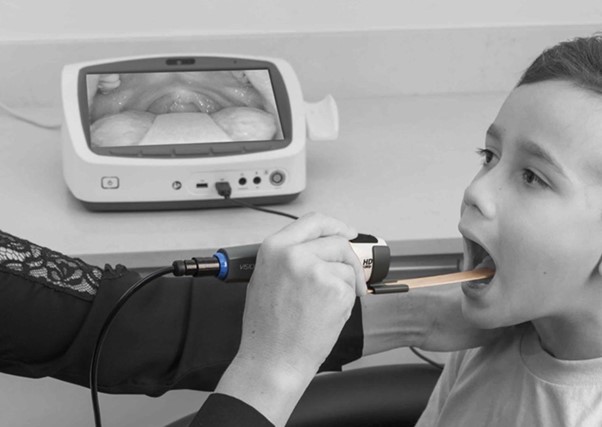
An example of innovation, taking leaps in the medical industry, is the Visionflex GEIS HD USB camera.
Peter Shandley, CEO of Tiller Design, an award-winning product design and innovation company, shares with us an inspiring innovation – the Visionflex GEIS HD USB camera, designed and manufactured collaboratively by Peter himself, Visionflex and Tiller Design.
This class 1 medical device is an integral part of a state-of-the-art solution needed to aid the difficulties and restrictions faced with remote patient imaging and diagnosis. This technology, currently being trialled in the field by organisations such as Royal Flying Doctor Service, remote health centres in outback Australia, Hunter Correctional Facility and even Dawson Station in Antarctica, is helping facilitate detailed examinations in one quick and easy online consultation.
It’s a handheld high-definition video camera with integrated LEDs that can work within the Visionflex operating system or independently via USB directly to the computer, which offers greater flexibility and commercial opportunity. Special attention went into designing such a tool that was intuitive and simple enough to use, anyone could learn in a matter of moments.
We want to continue working to support innovators so that technology, like this, continues to be developed to build a better world.